Bring We Are Dancing in the Forest to Life with a Multi-Instrument Play-Along
One of my favorite parts of summer is creating new resources that elementary music teachers can immediately take back to their classrooms. This post is an update from my summer series a few years back of play-along videos featuring songs and musical concepts commonly found in the Kodály and Orff Schulwerk approaches.
This week's featured resource is:
🌳 We Are Dancing in the Forest Play-Along
In this interactive play-along, students can perform the song using a variety of classroom instruments, making it easy to differentiate instruction and engage your entire music class.
Students can perform on:
Boomwhackers
Ukuleles
Xylophones
Recorders
Whether you're teaching whole-group instruction, centers, or instrument rotations, this video gives students the opportunity to make music together while reinforcing steady beat, melody, and ensemble skills.
Perfect for Kodály and Orff Approaches
We Are Dancing in the Forest is a wonderful song to incorporate into lessons centered around singing, movement, playing instruments, and musical literacy. The play-along format allows students to hear and see their part while developing independence and confidence as performers.
Because multiple instruments are included, you can:
Differentiate for various grade levels and ability levels.
Rotate instrument groups during class.
Reinforce melodic and rhythmic concepts in an engaging way.
Build ensemble skills while keeping every student actively involved.
Classroom Resources
Every play-along video in this summer series includes manipulatives to help you bring the lesson into your classroom right away.
Current resources include:
PowerPoint Slides presentation
Printable PDF lesson materials
Seesaw activity for your students
We Are Dancing In The Forest (METER OF 2, QUARTER NOTES, EIGHTH NOTES, AND S-L-M TONAL PATTERN)
The accompaniment is simple as it is just a melody line and a bass line of a separated tonic bordun of Do and Do’). The melody line is introduced first, followed by the bass line, and finished with both lines performed together in various melodic instruments found in the elementary music classroom.

Warmup
Since the tonal pattern is a focus of this activity, warming up our voices with sol-la-mi is how I begin this activity. Depending on whether this is in the preparation of introducing la, or the presentation, or practicing, this warm-up can be adapted to reach that certain goal.
I use this for practicing with a “Singing Simon Game” based on the game where Simon would play one note and the participant would play it back. Then Simon would add a note and the participant would copy it. This would continue with Simon adding more notes, one at a time until the participant makes a mistake and the game would end.
We would warm up in the same way where I would sing the pitch mi with the hand or body signal (see below in Melody), and the students would sing it back. I would then add sol, so the pattern is mi-sol. The students would then echo. I would then sing mi-sol-la and the students would echo. I would go to about six pitches and then ask a student to be the leader. No one gets “out” in this warmup. It is more for practicing the patterns and choosing a student to lead.
MELODY

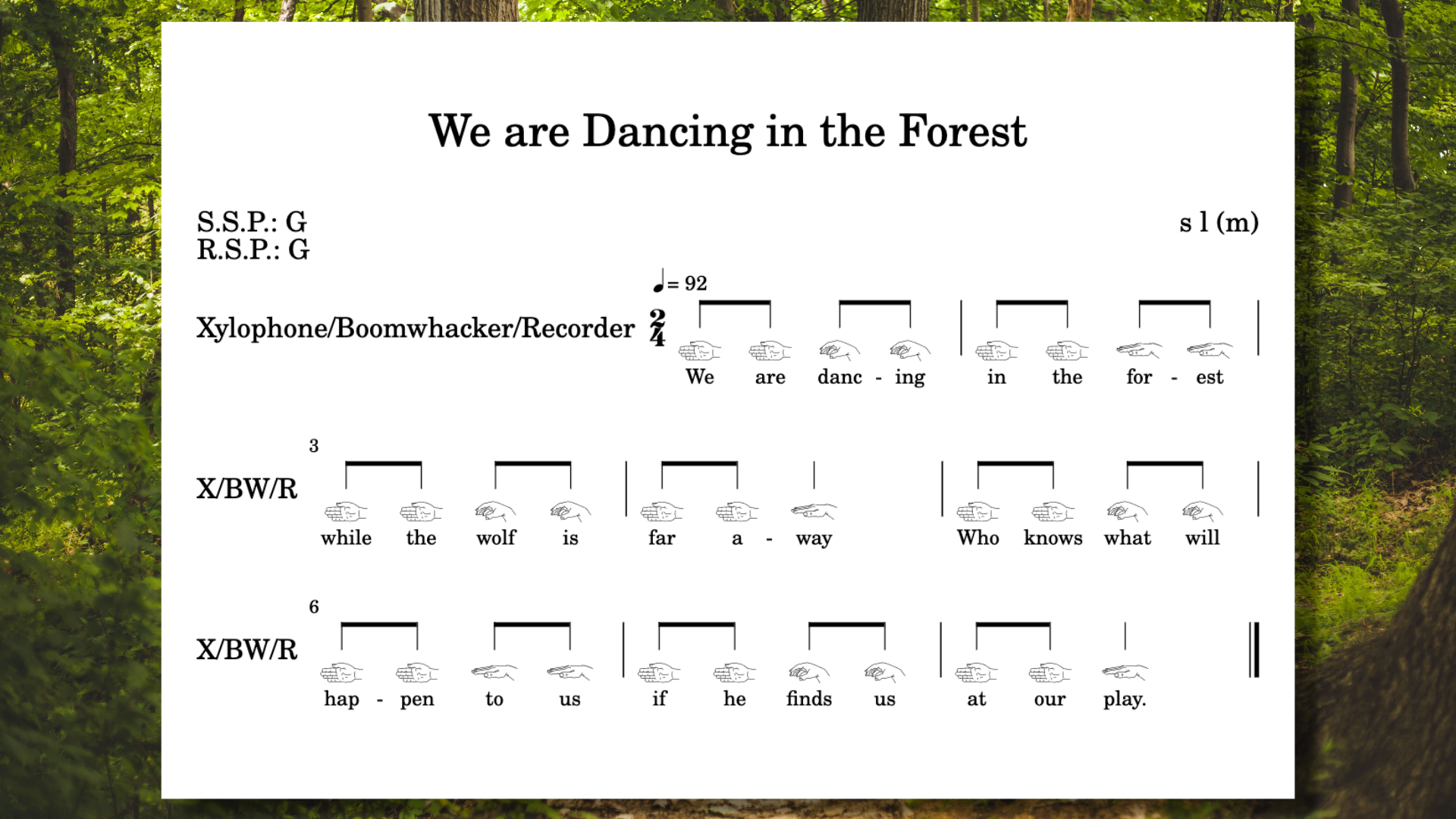
I have performed this activity and song with Kindergarten and above. When the recorders are added in the play-along, it is because we would revisit this song in third and fourth grade, depending on when they are ready to perform the note E.
After our warmup, we listen to the song. If the hand signals are being introduced by transferring body percussion to hand signals, then we convert sol by tapping the head, mi by tapping the shoulders, and la by tapping the air above our heads. We transfer that to the mi-sol-la-do-re-low sol hand signals.
I echo sing by phrase using solfege and hand signals. I then echo-sing two phrases. I ask them if the two phrases were the same (they are almost the same with the first phrase ending with eighth notes and the second phrase ending with a quarter note. I then echo-sing phrases three and then four. I ask them if phrases three and four same the same as one and two (they are the same).
To practice la, I will then sing the song without the la pitches as the students will sing those when they come up in the song. Finally, I echo-sing the words by each phrase, then two phrases, then four phrases. We then sing it together.
MOVEMENT ACTIVITY
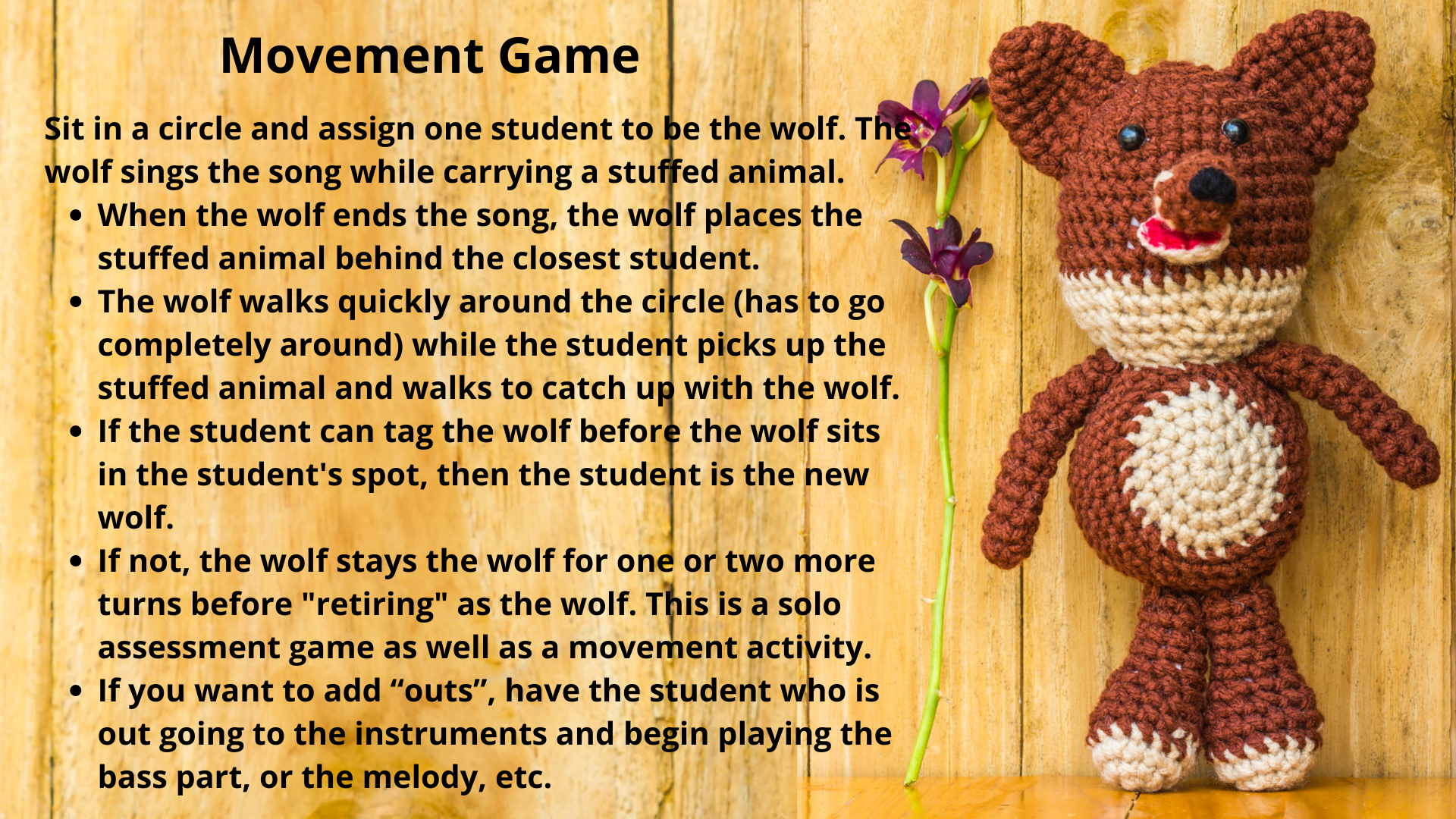
To reinforce the lyrics, and to assess solo singing, I have adapted a movement activity from “Charlie Over the Ocean” to “We are Dancing in the Forest”. You can adapt this for the readiness of your students.
Movement Game
Sit in a circle and assign one student to be the wolf. The wolf sings the song while carrying a stuffed animal.
When the wolf ends the song, the wolf places the stuffed animal behind the closest student.
The wolf walks quickly around the circle (has to go completely around) while the student picks up the stuffed animal and walks to catch up with the wolf.
If the student can tag the wolf before the wolf sits in the student's spot, then the student is the new wolf.
If not, the wolf stays the wolf for one or two more turns before "retiring" as the wolf. This is a solo assessment game as well as a movement activity.
If you want to add “outs”, have the student who is out going to the instruments and begin playing the bass part, or the melody, etc.
Bass Part
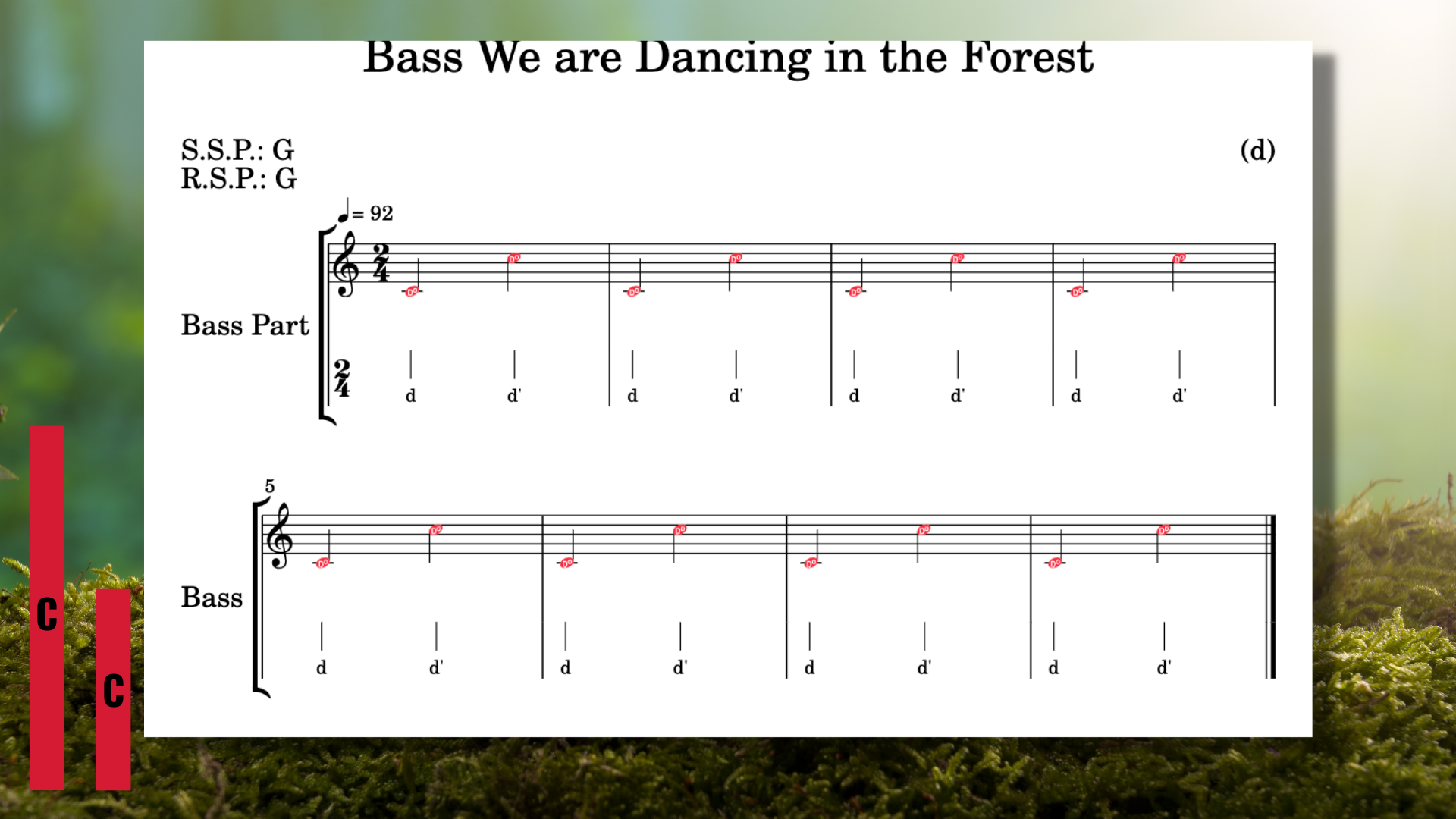
This bass part is a reinforcement of the steady beat. In my Orff Level 1 Class, we called this a tonic accompaniment as the bass part is only played on the Do and Do’ to the steady beat.
I begin with the students performing the steady beat on their laps with both of their hands patting together. Then, I ask them to separate with the first steady beat being performed with their left hand tapping their left leg, then their right hand tapping their right leg, and alternating after that. If they have trouble with lefts and rights, I can give them a scrunchy. We then transfer that to the C (left hand) and C’ (right hand) bars on the xylophones. Again, this can also be played with higher-pitched xylophones, virtual instruments, tone chimes, tone bars, and boomwhackers.
They all play the alternating tonic accompaniment and I sing and play the melody on my instrument.
Recorder and Boomwhacker Melody
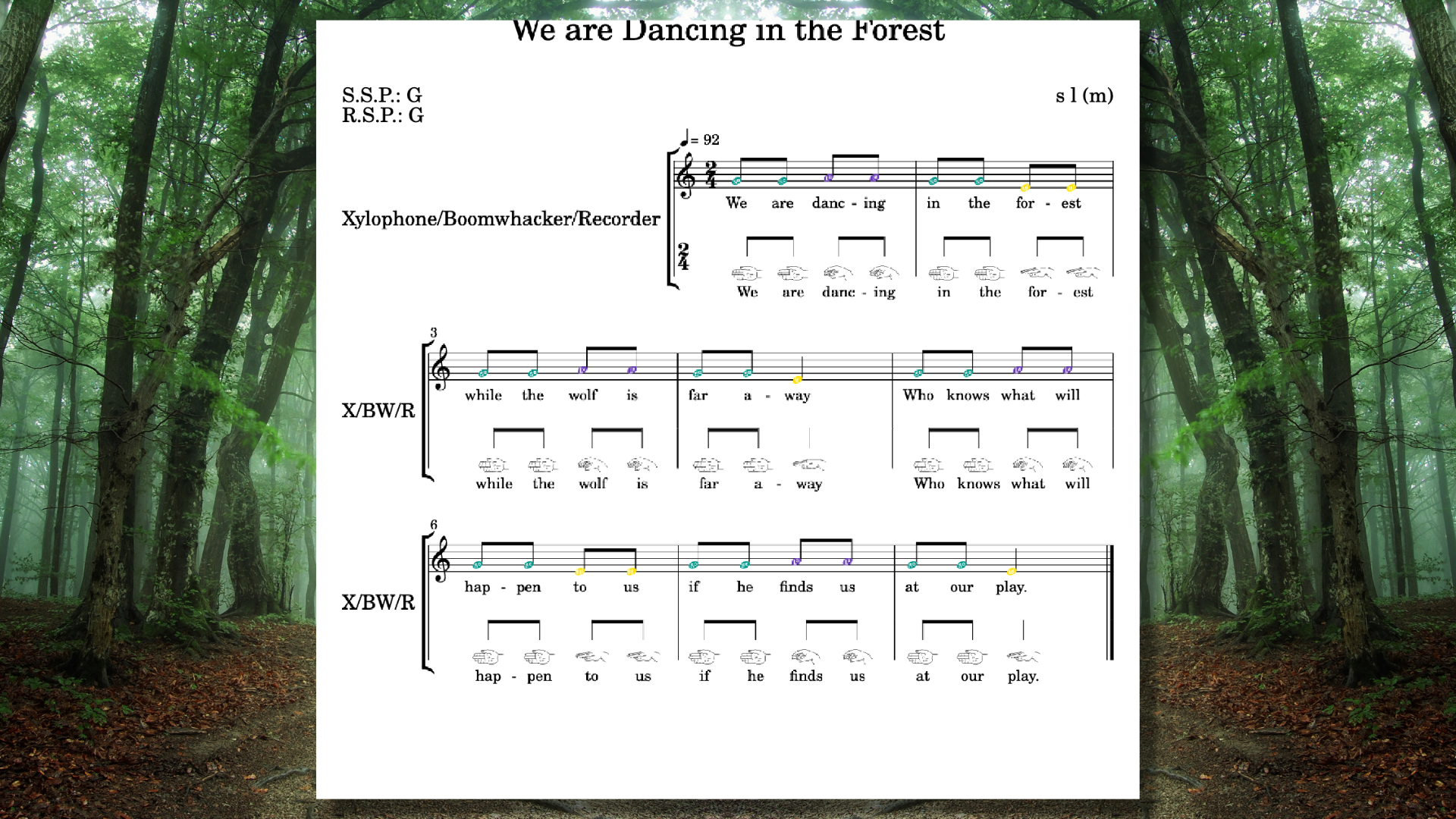


We revisit this song in grades three and four when they are ready to perform the note E on the recorder. We review the notes A (la and G (sol). We then make a “peace” sign with our right hand and add the two extra fingers to cover the next two holes so we can perform the note E. We discuss the importance of tonguing the notes so that the eighth notes are audible.
WHAT IF YOU DON’T HAVE ENOUGH INSTRUMENTS FOR YOUR STUDENTS?
That is where this lesson can be accomplished with xylophones, boomwhackers, tone chimes, tone bars, and virtual instruments. Since the melody has two pitches, you can supplement instruments that can play high and low, or the pitches of G and E, so that more students can perform. Virtual websites like Playxylo.com, my Scratch Boomwhackers site, and Dr. Musik’s website help when you might not have enough instruments, but you do have access to devices. This also helps students who cannot hold mallets in a traditional way so that they can make music alongside their classmates.
ALL PARTS
The next class brings all parts together as I review with the students how to play the melody and then the bass line. I divide the class in half and they play the parts together. If there are students without an instrument, they can perform the movement game and we switch throughout the class. We continue until all students have played the bass part, the melody, and the movement game.
Ukulele


Since this arrangement has a tonic accompaniment, if you have the pitch Do as the note C, you then can have students perform the C Chord on the ukulele to enhance the accompaniment. In my school, students as young as grade two learn and perform the ukulele.
Create a New Section


I usually integrate this song with a study of Prokofiev’s Peter and the Wolf. The rhythms of the characters and their instruments make up the new section. The students use this drag and drop activity (found in the Google Slides/PowerPoint and the Seesaw Activity included below) to create this new section. This can be done when Google Slides/PowerPoint is not in the preview mode. Though the gif I created a few years back shows me doing this in Canva, it would look the same in PowerPoint and Google Slides. When the section is created, we have a form of ABA where A is the melody and B is the newly created section.
MANIPULATIVES
The manipulatives below are available in my Extras page at https://buymeacoffee.com/elmusedtech/extras. They include Google Slides/PowerPoint and and PDF file. The free lesson plan is the post and the video is on the YouTube link listed below. The free Seesaw Activity is accessible by clicking the link below and using if you have a Seesaw Account), so that you can download and use them in the way that works best for your class.
Lesson Plan (this blog post)
Video: https://youtu.be/hCwj2SRlunY
📽️ PowerPoint Slides
https://buymeacoffee.com/elmusedtech/extras
📄 Printable PDF
https://buymeacoffee.com/elmusedtech/extras
💚 Seesaw Activity
https://app.seesaw.me/pages/shared_activity?prompt_id=prompt.49b4ebe7-65bd-48d8-802f-a95ce1a54873&share_token=DmycA2--QjqHlOUx6gERkw
Enjoying These Resources?
Creating these videos, lessons, and classroom materials takes many hours, and I love being able to share them with fellow music teachers around the world.
If these resources have been helpful to you or your students, please consider supporting my work by buying me a coffee:
☕ https://www.buymeacoffee.com/elmusedtech
Your support helps me continue creating free videos, classroom resources, and technology ideas for elementary music educators.
I hope We Are Dancing in the Forest brings joyful music-making to your classroom. If you use it with your students, I'd love to hear how it went!
Join Me!
If you're looking for more practical ideas, technology tips, and ready-to-use activities for elementary music, be sure to grab your free ticket to the Online Elementary Music Summit. You'll learn from dozens of elementary music educators and walk away with ideas you can use immediately in your classroom.
Get your free ticket here:
https://amy-burns--thatmusicteacher.thrivecart.com/all-access-pass-jul26-fa/