



Assessment: Using Recordings as an Assessment Tool
On October 31, we hold our school’s annual Halloween Parade/Fall Music Festival. In years where we did not have a snow storm or a major hurricane that knocked out power for days on end, we usually have weather that is nice and we prepare our Fall Songs. The PreK/K sang six songs for this year’s parade.


Example: Recording Songs for our Annual Halloween Parade:
On October 31, we hold our school’s annual Halloween Parade/Fall Music Festival. In years where we did not have a snow storm or a major hurricane that knocked out power for days on end, we usually have weather that is nice and we prepare our Fall Songs. The PreK/K sang six songs for this year’s parade. I recorded them using GarageBand app for the iPad (Price: free, but worth spending $4.99 for the upgrade). When we record ourselves, the kindergartners listen and evaluate their own performances. This results in them using musical terminology to describe their sounds (“we sang softly” or “we sang that very loud”, etc). In the past, I have used portable voice recorders (M-Audio), or Audacity on my laptop, or GarageBand or Soundtrap on my laptop connected to a snowball mic (this can also be done with the app with the inclusion of the camera connection kit as well as if you are working with an older iPad). Some of the song list consisted of:
1. Halloween is Coming: This song can be found by googling the title followed by "ha ha ha". We made this song into a finger play. I also brought out the combination of "h" and "a", the sound the two letters make together, and how it is the first two letters of Halloween.
2. Three Black Bats: I found this song in the book Holiday Piggyback Songs, which is a book of holiday songs sung to familiar children's songs. Three Black Bats is sung to the tune of Three Blind Mice. We created motions to use with this song and if you have advance enough singers, you can try to sing this song as a round.
3. "1 2 3 4" sung by Feist (video can be found here: http://safeshare.tv/w/zHPoeZVpmj): My concert theme for PreK this year is numbers. When I came across this song on the youtube sesame street channel when my oldest was 18 months, I immediately adored it. There are numerous songs from that show that are current pop tunes that were rewritten with educations lyrics for younger children. The three through five year-olds adore moving to song (we move like the animals named in the song) and singing the song.
4. This Old Ghost: Another favorite found in the book Holiday Piggyback Songs. This is a number songs that included four verses. The kindergartners made up three more to have the song go up to seven. They love to rhyme at this age and it was a fun activity for them to create new verses.
5. Five Little Pumpkins: A very popular song, poem, fingerplay, and numerous books can be found for this. Just by googling “five little pumpkins powerpoint”, I found this excellent powerpoint by Kelly Nyman on her kindergarten classroom website,http://www.kellyskindergarten.com/PowerPoints/powerpoints.htm. This powerpoint is synced to music that would not download, however, since we are music educators, we can supply the music and the students can supply the vocals.
6. The Day After Halloween by Greg Gilpin from So Much To Sing About! Ten Songs for Special Times Throughout the School Year. My students and my teachers love this song, especially the lines “It’s the day after Halloween. I’ve got the biggest sugar buzz you’ve ever seen ...my teacher wants to scream!” I used Audacity to import the song file, used the effects menu and scrolled down to “change tempo,” and slowed the tempo down on the song. This made it a little easier for the students to sing and chant the middle verse.
7. Skeleton Shake by David and Anne Ellsworth (Music K8 24/1) - My PreK and K loved this song because it had them singing and moving. They were able to create and perform their own movements. In this recording, you hear a clip of them singing with the recording.
8. Ghost and Goblins, Cats and Bats - Another favorite song found in the book Holiday Piggyback Songs. This song is especially great for younger children because it reminds the younger ones that Halloween is about dress-up and that the costumes are not real ghost and goblins, cats and bats. This recording was made over a decade ago, when I was a novice teacher. When I listen to this, I would not record the song with piano or with me singing along. I would now record this song the way I teach it: the students would sing the song acapella and with no assistance from me.
9. Me Gusta Mi Escuela by Mike Wilson (Music K8 19/1) - I have had my PreK/K sing this at our Fall Music Festival because it has my students singing in Spanish and English, and the students are singing about how much they love their school and their teachers. This is a very short clip.
10. Body Boogie by Teresa and Paul Jennings (Music K8 15/1) - This has been one of my students' favorite songs for years. This song has students moving and singing, as well as improvising or creating their own movements to the song. It improvising or creating their own movements to the song. It also has a great cross-curricular connection with the study of body parts. Finally, the accompanying big band sound track is wonderful.
11. Itsy Bitsy Spider - Halloween Version - I found this song through a Google search. The recording is of my kindergartners. One kindergartner got excited at the end and I had to cut off the ending. However, you will be able to identify the lyrics and the melody.
12. Do You Hear a Ghostly Sound? - During this song, the students would hide a scarf behind their backs until the final "Boo!". At the final "Boo!", the students would throw their scarves into the air. The students loved watching the scarf float down to the ground.
13. Do You Know It's Halloween? This song has the same melody as #12 and is a great opener to a Halloween Parade held on Halloween day.
If you would like the .notebook file for some the songs, you can find it here:
Photo credits: http://all-free-download.com

Math and Kindergarten/1st Grade: Using Groovy Music to Show Form in Kindergarten/1st Grade Music Class
In K and 1, the music educator and students can use the cloud-based software from MusicFirst called Groovy Music to create music. Consider this a “GarageBand” for younger students.
Using Groovy Shapes, music educators can reinforce shapes, colors and patterns while having the students create a song in a guided form. The students also experience musical terms such as dynamics, tempo, melodies, bass, chords, and more.
Using Groovy Jungle, students can experience creating a song using the same musical elements listed above. However, they can also use the text tool to write lyrics or poetry to their songs. It is a nice way to make a cross-curricular connection with writing. Finally, if your students are studying the rainforest, they can create a song about the rain forest that can have written facts using the knowledge they learned from science class.
Above you will find pictures and below you will find two video clips of Groovy Music. The first video shows the process of learning Vivaldi's "Spring" 1st Movement through movement with a parachute. The second video shows my Kindergartners’ composition using Groovy Shapes. They created a song with the same form of Vivaldi's Spring: ABACADAEA.

Integrate Across the Curriculum: Making a Book Come to Life
In kindergarten music class, we incorporate reading and identifying sight words in music literature. One of their favorite books is Eric Litman’s Pete the Cat. Last year, we performed two books from the series that emphasized singing, acting, math, and reading.
Picture credit: http://all-free-download.com/free-vector/download/book_knowledge_tree_310828.html

In kindergarten music class, we incorporate reading and identifying sight words in music literature. One of their favorite books is Eric Litman’s Pete the Cat. Last year, we performed two books from the series that emphasized singing, acting, math, and reading. This year, we made a video of the book with kindergartners singing and adding the narrations to the sight words and the words that they learned to read from this activity. We hope that you enjoy!
Photo credit: http://all-free-download.com/free-vector/download/book_knowledge_tree_310828.html

PreK Unit: Carnival of the Animals
In the spring, the PreK music classes prepare for a Grandparents’ Day Concert. This concert will feature a cross-curricular theme such as songs about numbers, or books, or around the world. Once the concert is completed, I introduce Saint-Saëns’s Carnival of the Animals.

In the spring, the PreK music classes prepare for a Grandparents’ Day Concert. This concert will feature a cross-curricular theme such as songs about numbers, or books, or around the world. Once the concert is completed, I introduce Saint-Saëns’s Carnival of the Animals. To experience this great piece of music, the students move as each animal, sometimes using props such as scarves and ribbon scarves, or instruments such as rhythm sticks. To further the study, we utilize the app, The Saint-Saens Carnival of the Animals (https://itunes.apple.com/us/app/saint-saens-carnival-animals/id475653515?mt=8 for $3.99), and the students will watch, listen, and interact with the app as they color pictures from the piece of music. The app has some wonderful interactions from connecting the dots to create a lion, to watching the orchestra perform each piece, to seeing the cartoon birds land on the instrumentalists, to watching the tortoise spin on his shell as he watches the orchestra. The coloring book and story pictures are a free printable download from The Wise Owl Factory and can be found here: http://thewiseowlfactory.com/BookaDay/archives/8401

Assessment: Using Explain Everything to Assess Rhythm Patterns
When I teach the song H E A R T to the tune of Bingo, I use the app Explain Everything to assess the rhythm used in the song. The song is as follows:

When I teach the song H E A R T to the tune of Bingo, I use the app Explain Everything to assess the rhythm used in the song. The song is as follows:
To show you like your special friend, just give them each a heart.
H E A R T
H E A R T
H E A R T
Each heart says “I Love You!”
Have the students sing and clap the rhythms in the song. Place five hearts on the Explain Everything screen and have the students use the draw tool to write the rhythms. Press the record button in Explain Everything to see their process and record the song.
Kindergarten Musical Creation: Their Chinese New Year Song
One of my favorite grades to teach is kindergarten. They are young enough to be sponges, but old enough to understand many of the musical concepts that you teach. For the Chinese New Year (the year of the rooster), kindergarten decided to create a music piece using virtual Chinese instruments.
Setting the Stage:
I had pre-recorded music from the Erhu playing as the kindergartners walked into the room. As they entered, the music was soothing and at a slower tempo, which calmed them. As they sat and listened, I asked them what country they thought the music was from. There were various answers until China was revealed to be the correct answer. We continued listening as I asked the students how the music made them feel. The responses varied from happy to sweet.
Adding Movement and Exploring Rhythms:
I took out the small wrist scarves from Music is Elementary and showed them three moves that I learned from an assembly about Chinese dancing. We performed the rainbow movement (paint a rainbow in the air), the waterfalls movement (wave the scarf from high to low), and the waves movement (wave the scarf from side to side). I then played the recording of Gong Xi, a favorite song we sing around the time of the Chinese New Year, and we moved together with our small wrist scarves.
After we put the scarves away, I took out two rhythm patterns found in the song, “Welcome Back to School.” We performed them with clapping and stamping to the music.
Exploring Instruments:
I do not have access to an Erhu and a Pipa. However, I do have iPads with the GarageBand app. I launched the app, pressed the + sign, tapped “Create New Song”, and then swiped until I found “WORLD”. I showed the Pipa and passed around the iPad for the students to explore by listening and playing the virtual instrument. With the Pipa, they were guided to perform one of the two rhythm patterns shown above. I would also quietly countdown from 5, so that they knew when their turn ended and they were to pass the iPad. We did the same for the Erhu. However, we further explored the different strokes of long and short, and the different melodic directions of high to low and low to high.
Creating Music:
I told the students that we were going to create our own Chinese New Year Song to share with our parents on Seesaw (a digital student learning journal). We reviewed how we could play the Erhu with long and short sounds as well as low and high sounds. I turned off the metronome and pressed the record button in the GarageBand app. The students would perform on the Erhu as I quietly counted down from five. Each student would pass the iPad around, performing their short melodies. Once finished, we listened to their recording. I found loops labeled “Chinese Traditional” in the loop library. We listened to a few Chinese Traditional Guzheng loops and decided on one to accompany their melody.
Sharing to Seesaw
Once completed, I clicked “Select” in the My Songs menu in GarageBand. I then clicked on the song and tapped the share sign. In the share menu, I scrolled over to the Seesaw icon, clicked on it, found the class to share it with, and clicked the green check. Their song is now accessible on their Seesaw journal where their parents can listen to it, read the description or listen to their child speak about it, and leave a comment if they choose to do so.
The kindergartners were so proud of their musical creation. They felt like they owned the song and they felt that their song was beautiful enough to share with the Chinese teacher at our school. I was so proud of how well and musically they played the virtual Erhu. Here is a snippet of our activity:

Performance: Performing their first melody on sol and mi
These are two examples of my kindergarten classes performing their first melody on the Orff instruments. The melody comes from an old series of music curriculum, but any sol mi song would do.

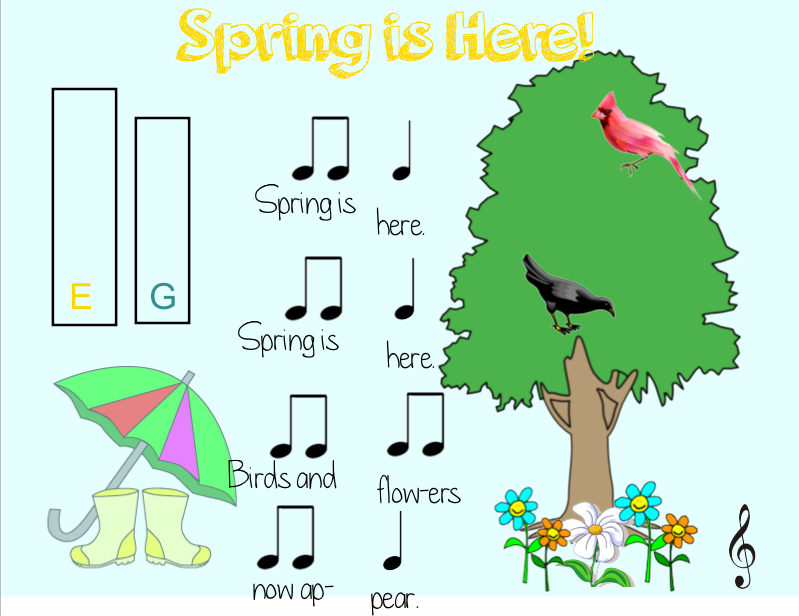
These are two examples of my kindergarten classes performing their first melody on the Orff instruments. The melody comes from an old series of music curriculum, but any sol mi song would do. We were learning, “Spring is here. Spring is here. Birds and flowers now appear.” Once they mastered the melody by singing, using body signals (head for sol and shoulders for mi), using hand signals, and moving to the pitches, we then learned to perform it on the Orff instruments. Once they were successful, I took one student who has a very good steady beat, and had him/her perform the steady beat on the contrabass bars. Finally, I used GarageBand and a snowball USB microphone to record them. Any recording app on a mobile device, tablet, or laptop would have worked as well.
I am very proud of my kindies!